
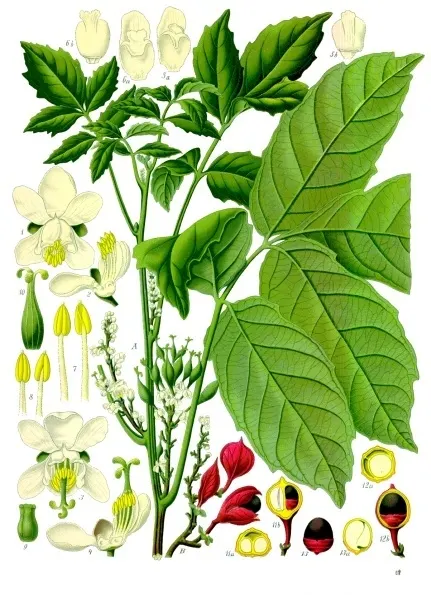
Guarana
Paullinia cupana
Edible plantPhoto credit: Franz Eugen Köhler, Köhler's Medizinal-Pflanzen
Safety information
Safety information
Toxicity: Effects are those of high-dose caffeine — insomnia, palpitations, tremor, anxiety, hypertension; overdose risk especially in concentrated supplements/energy drinks. Case reports of adverse cardiovascular events with high-caffeine guarana products.
Contraindications: Cardiac arrhythmia, hypertension, anxiety disorders, pregnancy/breastfeeding, peptic ulcer, caffeine sensitivity; children.
Interactions: Additive with other caffeine sources and stimulants (ephedra, synephrine); theophylline; CYP1A2-metabolized drugs; may amplify stimulant medications; caffeine reduces lithium levels.
Pregnancy & breastfeeding: Contraindicated in pregnancy/breastfeeding.
Evidence level
Supported by laboratory or animal studies; not yet confirmed in humans.
Preparations
tablets, capsules, energy drinks, syrups · seeds
Part used: seeds
roasted seed powder/paste grated into water · seeds
Part used: seeds
Traditional use: stimulant/tonic against fatigue; cognitive/physical performance; antidiarrheic, diuretic, antineuralgic; appetite suppressant
Proposed mechanism: very high caffeine content (seeds up to ~4-6%), plus theophylline/theobromine, tannins, saponins (antioxidant)
Dosage note (descriptive only): overdose risk in concentrated supplements/energy drinks
Associated conditions
Edibility
Edible parts: Roasted/processed seed consumed only as powdered beverage/flavoring, not eaten raw (bitter, high tannin/caffeine).
Toxic lookalike warning
Other Paullinia species (P. pinnata) are toxic — do not forage wild Paullinia.
Nutritional notes
Mainly caffeine/methylxanthines; tannins, saponins, catechins/epicatechins (antioxidant). Not a meaningful macronutrient source.
Healing traditions
Related plants
- Daruharidra (tree turmeric / Indian barberry)Berberis aristataClinical
- Musta (nutgrass)Cyperus rotundusClinical
- Khadira (black catechu / cutch tree)Acacia catechuClinical
- Kalgan / TormentilPotentilla erectaClinical
- Sangre de grado / Dragon's bloodCroton lechleriClinical
- Amur cork tree bark / huang bai (黄柏)Phellodendron amurenseClinical
Sources (2)
- Paullinia cupana Kunth review, J Ethnopharmacol, 2015
- Guarana — LiverTox (NBK589113), NIH/NIDDK
Sourcing & resources
Affiliate links — we may earn a small commission at no extra cost to you.