
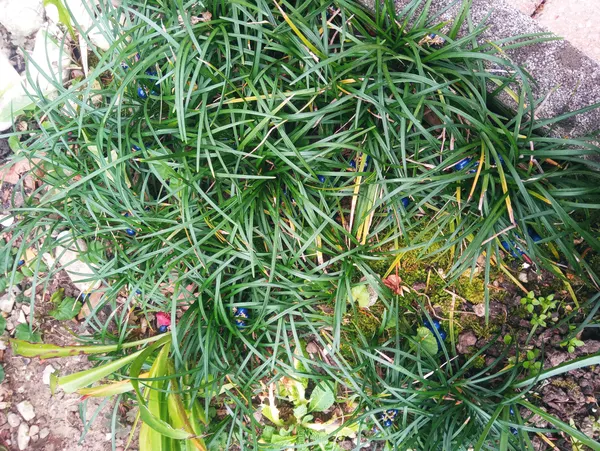
Mai dong / dwarf lilyturf
Ophiopogon japonicus
Other names: 麦冬 / 麥冬 màidōng; 麦门冬 màiméndōng, Mai dong / dwarf lilyturf
Photo credit: Shabicht
Safety information
Safety information
Toxicity: Generally low-toxicity in traditional use; comprehensive human safety data limited.
Contraindications: Traditionally cautioned in spleen-deficiency with dampness/diarrhea; pregnancy/clinical data limited.
Interactions: Not well characterized.
Pregnancy & breastfeeding: Data limited.
Evidence level
Supported by laboratory or animal studies; not yet confirmed in humans.
Preparations
decoction · root tuber
Part used: root tuber
Traditional use: nourishing yin, moistening lung, generating fluids, clearing heat-from-deficiency (dry cough, dry-mouth)
Proposed mechanism: steroidal saponins (ophiopogonins), homoisoflavonoids
powder · root tuber
Part used: root tuber
Associated conditions
Nutritional notes
Not a nutritional food; steroidal saponins and homoisoflavonoids.
Healing traditions
Related plants
Sources (2)
- Ophiopogon japonicus (Wikipedia), English, accessed 2026, https://en.wikipedia.org/wiki/Ophiopogon_japonicus
- Ophiopogon - Memorial Sloan Kettering About Herbs, English, https://www.mskcc.org/cancer-care/integrative-medicine/herbs/ophiopogon
Sourcing & resources
Affiliate links — we may earn a small commission at no extra cost to you.