
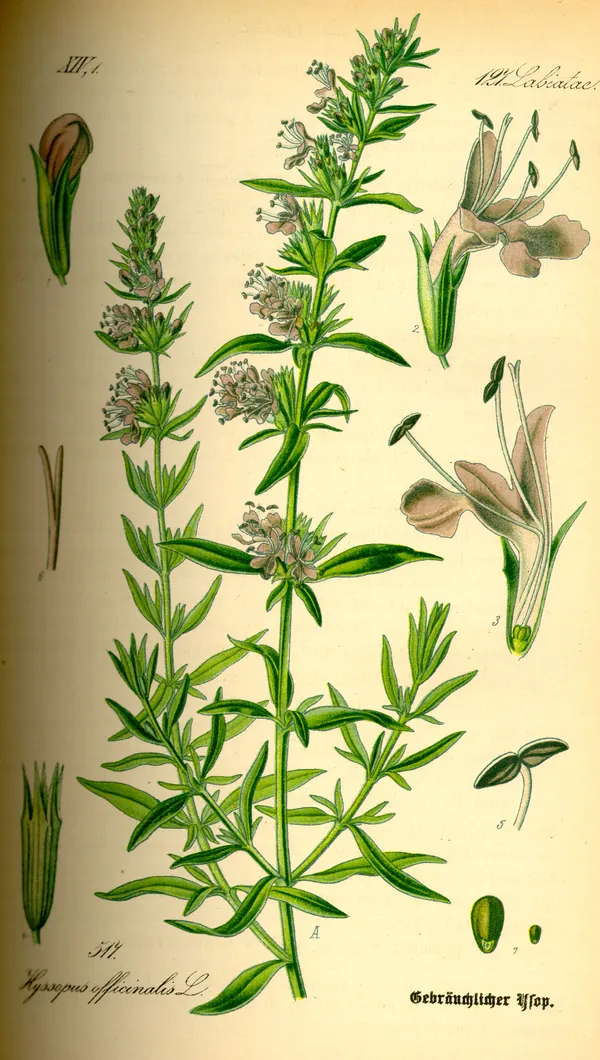
Hyssop
Hyssopus officinalis
Other names: Hyssop
Edible plantPhoto credit: Otto Wilhelm Thomé, Flora von Deutschland
Safety information
Safety information
Toxicity: Contains thujone in the volatile oil (general thujone caution).
Contraindications: None specifically named.
Interactions: None reported (thujone additive with other thujone herbs implied).
Evidence level
Documented in systematic traditional medicine literature.
Preparations
infusion · aerial parts
Part used: aerial parts
Traditional use: Traditionally used as an antispasmodic expectorant for coughs, bronchitis and chronic catarrh, as a diaphoretic for the common cold, and as a nervine for anxiety.
How to prepare (traditional): Infusion: pour 1 cup of boiling water over 1-2 teaspoons of dried herb and infuse, covered, 10-15 minutes.
Dosage note (descriptive only): Drunk three times a day.
tincture · aerial parts
Part used: aerial parts
Traditional use: Expectorant.
How to prepare (traditional): Tincture at 1:5 in 45% alcohol.
Dosage note (descriptive only): 1-4 ml three times a day.
Associated conditions
Edibility
Edible parts: culinary herb in small amounts
Nutritional notes
Culinary aromatic.
Healing traditions
Related plants
Sources (1)
- Hoffmann D., Medical Herbalism (2003) — David Hoffmann (2003)
Sourcing & resources
Affiliate links — we may earn a small commission at no extra cost to you.