
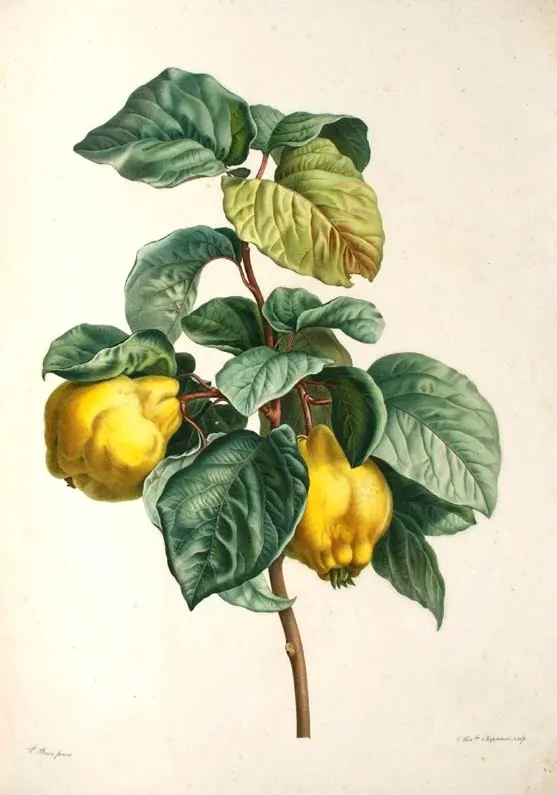
Quince
Cydonia oblonga
Other names: Quince
Edible plantPhoto credit: Pancrace Bessa (1772-1846)
Safety information
Safety information
Toxicity: Flesh none known. Seeds contain cyanogenic compounds (amygdalin) — do not crush/swallow seeds in quantity.
Contraindications: None documented for fruit.
Interactions: None documented.
Evidence level
Found in historical texts; limited or no modern study. Folk and historical sources have not been validated by clinical research.
Preparations
decoction · fruit
Part used: fruit
Traditional use: coughs (with violet, licorice), heart complaints, soothing food(Folk and historical sources have not been validated by clinical research.)
Proposed mechanism: cooling/astringent
Associated conditions
Edibility
Edible parts: Fruit edible cooked (raw it is hard/astringent); seeds NOT for eating.
Toxic lookalike warning
Low risk (distinctive fruit).
Healing traditions
Related plants
Sources (2)
- Mtsire Karabadini, Part II (Surmanidze, 1990) — Ramaz Surmanidze (1990)
- Karabadini (Khelaia ed., 2009) — Nani Khelaia (ed.) (2009)
Sourcing & resources
Affiliate links — we may earn a small commission at no extra cost to you.