
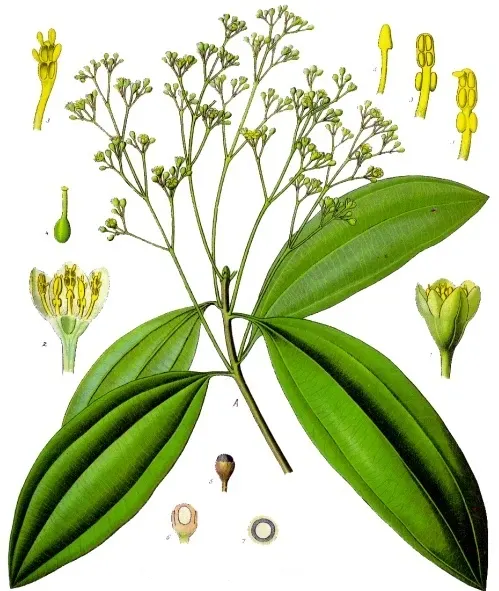
Chinese cassia / cinnamon
Cinnamomum cassia
Other names: 肉桂 ròuguì; 桂枝 guìzhī, Chinese cassia / cinnamon
Edible plantPhoto credit: Franz Eugen Köhler, Köhler's Medizinal-Pflanzen
Safety information
Safety information
Toxicity: Contains coumarin, which can damage the liver in larger amounts; European agencies warn against high cassia intake. Cinnamaldehyde and styrene can be toxic in high doses.
Contraindications: Pregnancy (high doses); liver disease; caution combining with anticoagulants (coumarin).
Interactions: Theoretical additive effect with anticoagulants; possible additive hepatotoxicity at high intake.
Pregnancy & breastfeeding: Caution at high doses.
Evidence level
Supported by laboratory or animal studies; not yet confirmed in humans.
Preparations
powder · bark
Part used: bark
essential oil · bark
Part used: bark
edible spice · bark
Part used: bark
Traditional use: culinary(Folk and historical sources have not been validated by clinical research.)
decoction · bark
Part used: bark
Traditional use: warming the interior/kidney yang (rougui); twig (guizhi) releases the exterior
Proposed mechanism: cinnamaldehyde, coumarin
Dosage note (descriptive only): avoid high daily intakes (coumarin)
Associated conditions
Edibility
Edible parts: Bark is a common culinary spice (powder/sticks), buds occasionally used. Eat in normal culinary amounts; avoid high daily intakes due to coumarin.
Nutritional notes
Functional spice; aromatic essential oil rich in cinnamaldehyde; coumarin present.
Healing traditions
Related plants
- Tibetan anisodus / 'Tang-chu-tang'Anisodus tanguticusClinical
- Siberian Ginseng (Eleuthero)Eleutherococcus senticosusClinical
- Liquorice / LicoriceGlycyrrhiza glabraClinical
- Goji Berry (Chinese Wolfberry)Lycium chinenseClinical
- Amla (Indian gooseberry)Phyllanthus emblicaClinical
- Rhodiola (Roseroot)Rhodiola roseaClinical
Sources (3)
- Cinnamomum cassia (Wikipedia), English, accessed 2026, https://en.wikipedia.org/wiki/Cinnamomum_cassia
- Zhang et al., Cinnamomum cassia Presl: A Review of Its Traditional Uses, Phytochemistry, Pharmacology and Toxicology, Molecules 2019, PMC6804248
- Hajimonfarednejad et al., Cinnamon: A systematic review of adverse events, Clin Nutr 2018/2019, PMID 29661513
Sourcing & resources
Affiliate links — we may earn a small commission at no extra cost to you.