
Safety information
Safety information
Toxicity: Contains oxalic acid. | Low as a food green. Medicinal flowering-plant preparations have uterotonic/haemostatic activity — not a casual herb.
Contraindications: Patients with kidney stones should avoid it (oxalic acid). | Pregnancy (uterotonic/'to bring on bleeding' reputation — avoid medicinal doses); cardiac/blood-pressure conditions and anticoagulant therapy (caution with the medicinal plant); thyroid (goitrogenic Brassicaceae in large raw amounts).
Interactions: None specifically reported. | Theoretical interaction with anticoagulants/antiplatelets (haemostatic) and with cardiac/antihypertensive drugs; possible additive with uterotonics.
Pregnancy & breastfeeding: Avoid medicinal doses (uterotonic reputation).
Evidence level
Supported by laboratory or animal studies; not yet confirmed in humans.
Preparations
infusion · aerial parts
Part used: aerial parts
Traditional use: Traditionally used as a gentle diuretic and astringent for water retention, diarrhoea, nosebleeds, and to reduce excessive menstrual flow.
How to prepare (traditional): Infusion: pour 1 cup of boiling water over 1-2 teaspoons of dried herb and infuse 10-15 minutes.
Dosage note (descriptive only): For menstrual conditions, a cup every 2-3 hours just before and during the period; otherwise drunk three times a day.
tincture · aerial parts
Part used: aerial parts
Traditional use: Astringent / urinary remedy.
How to prepare (traditional): Tincture at 1:5 in 25% alcohol.
Dosage note (descriptive only): 1-2 ml three times a day.
Associated conditions
Edibility
Edible parts: leaves are edible (wild green) | young rosette leaves raw/cooked (peppery, mustard-family)
Toxic lookalike warning
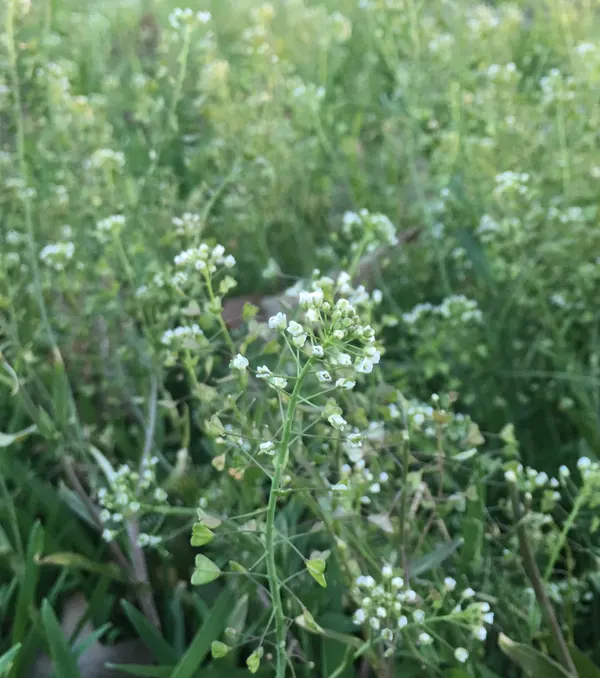
Small white-flowered Brassicaceae can be confused with other wild crucifers — positive ID needed if foraging. | The distinctive heart/purse-shaped seed pods identify it when present, but young rosettes resemble other Brassicaceae and composites; confirm the plant and avoid unknown rosette greens.
Nutritional notes
Wild edible green. | Vitamin C, vitamin K, provitamin-A, calcium and iron; peppery low-calorie green.
Healing traditions
Related plants
- Daruharidra (tree turmeric / Indian barberry)Berberis aristataClinical
- Musta (nutgrass)Cyperus rotundusClinical
- Khadira (black catechu / cutch tree)Acacia catechuClinical
- Kalgan / TormentilPotentilla erectaClinical
- Sangre de grado / Dragon's bloodCroton lechleriClinical
- Amur cork tree bark / huang bai (黄柏)Phellodendron amurenseClinical
Sources (2)
- Hoffmann D., Medical Herbalism (2003) — David Hoffmann (2003)
- Bussmann et al., A comparative ethnobotany ... Republic of Georgia, J Ethnobiol Ethnomed 2016;12:43
Sourcing & resources
Affiliate links — we may earn a small commission at no extra cost to you.