
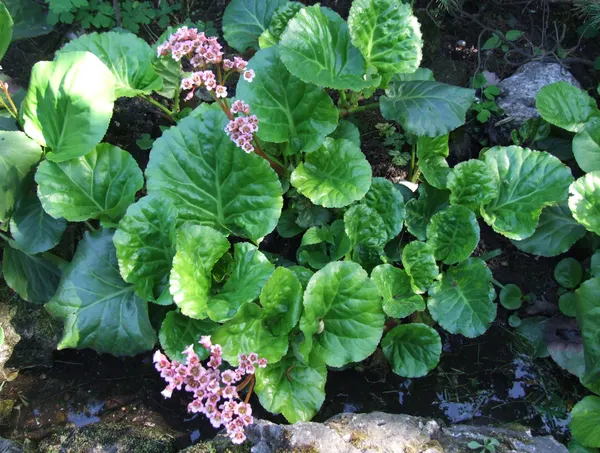
Badan (Siberian tea / leather bergenia)
Bergenia crassifolia
Edible plantPhoto credit: Jerzy Opioła
Safety information
Safety information
Toxicity: Mild. Tannin-heavy decoctions can cause constipation, nausea/GI irritation and reduce nutrient/mineral absorption with prolonged heavy use; arbutin yields hydroquinone (theoretical concern with chronic high intake).
Contraindications: Constipation-prone individuals; chronic high-tannin intake; caution in pregnancy and in young children (insufficient safety data); not for prolonged self-treatment of diarrhoea without diagnosis.
Interactions: Tannins can bind and reduce absorption of iron, alkaloid drugs and some other oral medications (separate dosing).
Pregnancy & breastfeeding: Caution in pregnancy (insufficient safety data).
Evidence level
Supported by laboratory or animal studies; not yet confirmed in humans.
Preparations
powder · rhizome/root
Part used: rhizome/root
infusion (tea, esp. from blackened leaves) · over-wintered leaves
Part used: over-wintered leaves
Traditional use: daily Siberian/Mongolian tea
decoction · rhizome/root
Part used: rhizome/root
Traditional use: strong astringent for diarrhoea/dysentery, gargle for sore throat/stomatitis, gynaecological douches, topical on bleeding/wounds
Proposed mechanism: gallotannins, bergenin (C-glucoside), arbutin — astringent, antimicrobial, antioxidant, haemostatic
Associated conditions
Edibility
Edible parts: The over-wintered blackened leaves are used as a tea; young rhizome is bitter/astringent and used medicinally.
Toxic lookalike warning
The medicinal blackened leaves are only the over-wintered (naturally fermented) ones; do not confuse ornamental/garden Bergenia hybrids or unrelated broad rosette leaves — identify to species before use.
Nutritional notes
High tannin/polyphenol content; the leaf tea is a folk vitamin/astringent beverage rather than a nutrient source.
Healing traditions
Related plants
- Daruharidra (tree turmeric / Indian barberry)Berberis aristataClinical
- Musta (nutgrass)Cyperus rotundusClinical
- Khadira (black catechu / cutch tree)Acacia catechuClinical
- Kalgan / TormentilPotentilla erectaClinical
- Sangre de grado / Dragon's bloodCroton lechleriClinical
- Amur cork tree bark / huang bai (黄柏)Phellodendron amurenseClinical
Sources (2)
- Koul et al. 2020, Molecules (PMC7730924)
- Pandey et al. 2024, Front Pharmacol (PMC11743450)
Sourcing & resources
Affiliate links — we may earn a small commission at no extra cost to you.