
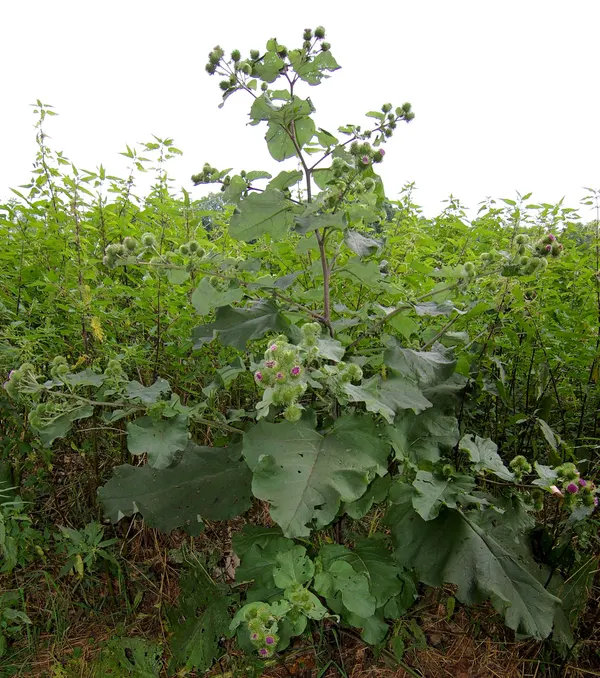
Burdock
Arctium lappa
Other names: Burdock, local names for the big-leaved roadside plant, Greater burdock
Edible plantPhoto credit: Christian Fischer
Safety information
Safety information
Toxicity: Root generally low toxicity (a food). Contact dermatitis from the plant reported; rare anticholinergic poisoning has occurred from burdock-root TEA contaminated/adulterated with atropine-containing belladonna-type material - a quality/adulteration hazard, not the plant itself. | None known (very rarely contact dermatitis). | Possible allergic reactions in Asteraceae-sensitive people. | Root/stalk: none known as food. (Commercial burdock-root teas have rarely been adulterated with toxic belladonna root — a sourcing/identification hazard, not the plant itself.) | Low for properly identified cultivated/wild burdock root. Reports of atropine poisoning have come from burdock-root tea/products adulterated with belladonna — a sourcing hazard, not intrinsic toxicity.
Contraindications: Hypersensitivity (Asteraceae). Diuretic folk use: caution in dehydration/fluid-balance issues. Pregnancy: traditional caution (uterine-stimulant claims) - avoid medicinal doses; limited data. | None significant; using burdock alone can flare eczema (combine with eliminative herbs). | None specifically reported. | Pregnancy (traditional uterine/'blood' use — avoid medicinal doses); diabetics monitor (hypoglycaemic signal); Asteraceae allergy. | Asteraceae allergy; caution in pregnancy (uterine-stimulant claims, insufficient data).
Interactions: Theoretical additive effect with diuretics and antidiabetics (possible glucose-lowering) - consult provider. | None specifically noted. | None specifically reported. | Theoretical additive with diuretics and antidiabetics; mild. | Theoretical additive hypoglycaemic effect (inulin/observed glucose effects); theoretical diuretic interaction.
Pregnancy & breastfeeding: Traditional caution (uterine-stimulant claims) - avoid medicinal doses; limited data. | Avoid medicinal doses (traditional uterine/'blood' use). | Caution in pregnancy (uterine-stimulant claims, insufficient data).
Evidence level
Supported by laboratory or animal studies; not yet confirmed in humans.
Preparations
infusion · seed
Part used: seed
Traditional use: Used as a wash for acne and boils.
How to prepare (traditional): Infusion of the seeds, used as a wash.
poultice · leaf
Part used: leaf
Traditional use: Applied to abscesses and boils.
How to prepare (traditional): Poultice of the leaves.
decoction · root
Part used: root
Traditional use: For pimples, arthritis, and skin disorders.
How to prepare (traditional): For pimples, make a decoction with 2 tsp burdock root and 5 tsp dandelion root; a plain root decoction is an alternative to tincture for arthritis and skin disorders.
Dosage note (descriptive only): Drink 3/4 cup (150 ml) twice a day (pimple remedy). For arthritis/skin: drink about 7 tsp once a day for up to 4 weeks.
tincture · root
Part used: root
Traditional use: Alterative / skin remedy.
How to prepare (traditional): Tincture at 1:5 in 40% alcohol.
Dosage note (descriptive only): 2-4 ml three times a day.
Associated conditions
Edibility
Edible parts: root cooked as a vegetable (gobo), common in Japanese/Korean cooking; young leaf stalks/peeled stems also eaten cooked | root is a cultivated vegetable (gobo, Asian cuisine), eaten cooked; young leaves edible | root is eaten (e.g., gobo) | first-year root and peeled young stalks, cooked | Long taproot, cooked (peeled, often soaked to reduce astringency/oxidation).
Toxic lookalike warning
First-year burdock rosettes/roots can be confused by foragers with deadly nightshade/belladonna (Atropa belladonna) and with dock/rhubarb relatives; historical atropine-poisoning cases underline the need for positive identification and reputable sourcing. | Burdock's large first-year leaves resemble those of toxic foxglove (Digitalis) and butterbur — confirm by hooked burs/round leaf base before harvesting wild root. | Burdock leaves/roots can be confused with toxic Atropa belladonna or Xanthium (cocklebur) — positive ID essential before eating. | CRITICAL (root foraging): burdock's large rhubarb-like basal leaves and taproot can be confused with deadly lookalikes — leaves resemble foxglove (Digitalis, lethal); root historically confused/adulterated with deadly nightshade/belladonna (Atropa, lethal) root. Confirm Arctium (huge leaves, hooked burrs in second year) and never dig or buy unverified burdock root; do not gather rosette leaves you cannot identify. | Basal leaves and taproot confused with common mullein (harmless) but more dangerously with deadly nightshade (Atropa belladonna) root in mixed hedgerow digs and with dock/comfrey roots; comfrey (Symphytum) contains hepatotoxic pyrrolizidine alkaloids. Historical burdock-tea atropine poisonings due to belladonna contamination — never harvest from a patch where belladonna grows.
Nutritional notes
Functional food - root provides inulin (prebiotic fibre), potassium, some polyphenols; low calorie. | Root rich in inulin (up to ~45%), a prebiotic fibre. | Inulin (45–50%), mucilage, pectin, sugars; dietary fiber role. | Root rich in inulin (prebiotic fibre) and potassium with some minerals; young stalks provide fibre and minerals — a functional prebiotic root vegetable. | Root is a major source of inulin (prebiotic fructan), dietary fibre, potassium; low fat. Functional/prebiotic role.
Healing traditions
Related plants
Sources (9)
- Chevallier A., Encyclopedia of Herbal Medicine (2016) — Andrew Chevallier (2016)
- Hoffmann D., Medical Herbalism (2003) — David Hoffmann (2003)
- Bussmann et al., A comparative ethnobotany ... Republic of Georgia, J Ethnobiol Ethnomed 2016;12:43
- Bussmann et al., Unity in diversity — food plants of Sakartvelo, 2021
- Standard Western/East Asian ethnobotany and herbal references
- published case reports of anticholinergic poisoning from adulterated burdock-root tea (toxicology literature)
- Yang 2025 Front Pharmacol (PMC12531496)
- Chen 2024 fermented-root study (PMC11551023)
- USDA FoodData Central (burdock root, cooked)
Sourcing & resources
Affiliate links — we may earn a small commission at no extra cost to you.