
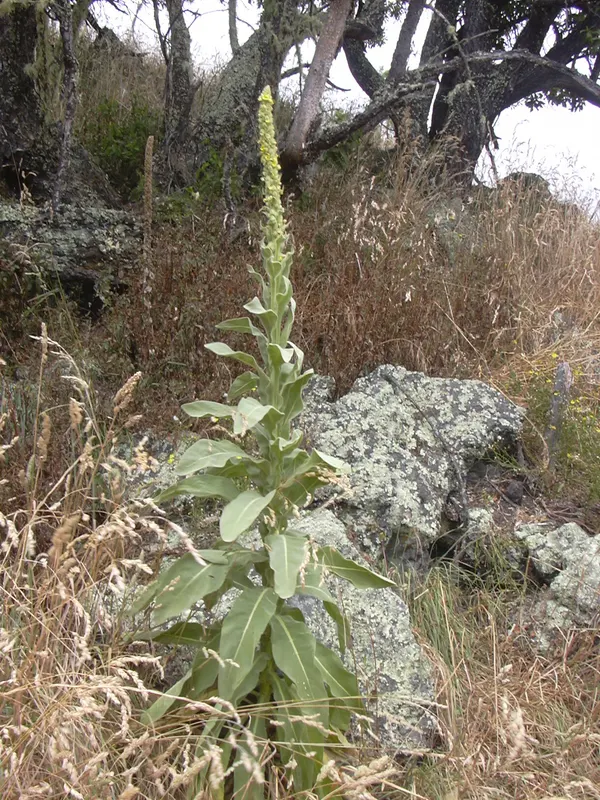
Mullein
Verbascum thapsus
Other names: Mullein, Great Mullein
Photo credit: Forest & Kim Starr
Safety information
Safety information
Toxicity: Generally low toxicity. The fine leaf hairs are mechanically irritant (skin/throat) - strain teas well. Mullein SEEDS contain saponins/rotenoids and are toxic (historically used to stupefy fish) - only flowers and leaf are used, not seeds. | Leaves/flowers mild; whole plant slightly sedative/narcotic. The seeds contain saponins and are narcotic - historically a fish poison. Leaf hairs cause throat itching, so preparations must be strained. | None known reported.
Contraindications: Hypersensitivity. Ear-oil use is inappropriate if the eardrum may be perforated or for ear infections needing medical care - earache must be evaluated, especially in children. Limited pregnancy data. | None specified by source. | None specifically reported.
Interactions: None well documented; theoretical only. | None specified by source. | None reported.
Pregnancy & breastfeeding: Limited pregnancy data.
Evidence level
Documented in systematic traditional medicine literature.
Preparations
infusion/decoction of leaves in milk or water (strained), flower infusion, flower-infused oil (ear drops), dried leaves smoked, poultices, homeopathic tincture · leaves/flowers
Part used: leaves/flowers
Traditional use: chest complaints, coughs, bronchitis, consumption (leaf decoction in milk); respiratory irritation and asthma (smoked); earache, piles, frostbite, bruises (flower oil); haemorrhoids (poultices)
Proposed mechanism: demulcent/emollient/astringent; modern herbalism still uses flower oil for earache and leaf for coughs
tincture · leaf
Part used: leaf
Traditional use: respiratory
flower-infused oil (external) · flower
Part used: flower
Traditional use: inflamed surfaces and ear problems
infusion (tea) / syrup / infused mullein flower oil (traditional ear-oil) / liquid extract · flowers and leaf
Part used: flowers and leaf
Traditional use: folk/traditional use as a demulcent/expectorant for dry, irritating coughs and bronchial/throat irritation; traditional infused-oil use for earache (otitis)(Folk and historical sources have not been validated by clinical research.)
Proposed mechanism: mucilage (demulcent), saponins and iridoids (proposed expectorant/anti-inflammatory) and verbascoside (antioxidant/antimicrobial in vitro) - preclinical; respiratory soothing is main traditional rationale
Dosage note (descriptive only): traditional infusion of flowers/leaf several times daily (strain through fine cloth to remove irritant leaf hairs); infused oil for traditional ear use; descriptive only
infusion · leaf
Part used: leaf
Traditional use: expectorant/demulcent/anti-inflammatory respiratory remedy — specific for bronchitis with a hard cough and soreness; tones respiratory mucous membranes
Proposed mechanism: mucilage/saponin/flavonoid chemistry
Dosage note (descriptive only): strain well to remove hairs
Associated conditions
Nutritional notes
Not relevant (beverage/medicinal use). | Not relevant.
Healing traditions
Related plants
Sources (4)
- Grieve M., A Modern Herbal (1931) — Maud Grieve (1931)
- Hoffmann D., Medical Herbalism (2003) — David Hoffmann (2003)
- Standard Western ethnobotany/herbal references
- small published trials of combination herbal ear drops (otitis) noting mullein as a component
Sourcing & resources
Affiliate links — we may earn a small commission at no extra cost to you.