
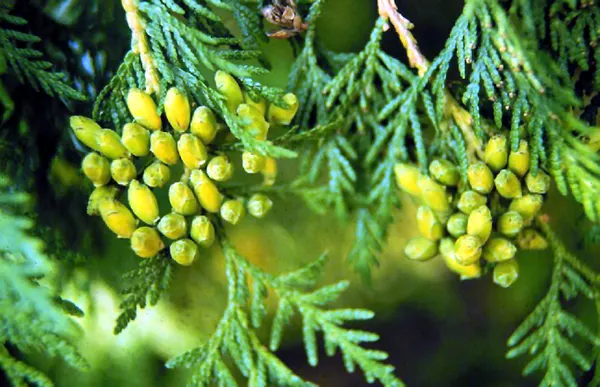
This plant carries serious safety risks. All information is for educational reference only.
Safety information
Toxicity: Serious — contains thujone; large doses may be toxic; additive with other thujone-containing herbs.
Contraindications: Avoid during pregnancy (uterine reflex action); avoid in dry/irritable coughs (overstimulation).
Interactions: Additive thujone toxicity with other thujone-containing herbs (sage, wormwood, tansy).
Pregnancy & breastfeeding: Avoid during pregnancy (uterine reflex action / abortifacient).
Evidence level
Documented in systematic traditional medicine literature.
Preparations
This plant carries serious safety risks. All information is for educational reference only.
tincture · young twig
Part used: young twig
Traditional use: expectorant/antimicrobial alterative — bronchial catarrh with heart weakness; reflex uterine action (delayed menstruation); incontinence; psoriasis/rheumatism
Proposed mechanism: volatile oil (thujone) alterative action
external application (diluted) · young twig
Part used: young twig
Traditional use: antifungal for ringworm/thrush; warts
Dosage note (descriptive only): diluted
Reference only — not a dosage instruction
infusion · young twig
Part used: young twig
Traditional use: alterative
Associated conditions
Healing traditions
Related plants
Sources (1)
- Hoffmann D., Medical Herbalism (2003) — David Hoffmann (2003)