
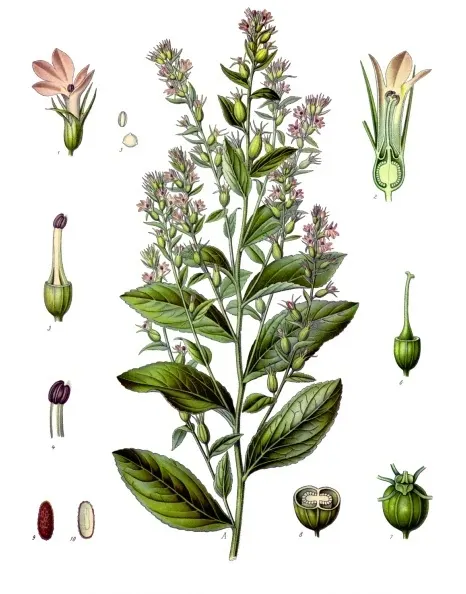
Lobelia
Lobelia inflata
Other names: Lobelia
Photo credit: Franz Eugen Köhler, Köhler's Medizinal-Pflanzen
This plant carries serious safety risks. All information is for educational reference only.
Safety information
Toxicity: Serious — effects resemble nicotine/tobacco: nausea, vomiting, diarrhea, coughing, tremors, dizziness; overdose: profuse sweating, tachycardia, convulsions, hypothermia, hypotension, coma.
Contraindications: Should not be used during pregnancy or lactation.
Interactions: None specifically reported.
Pregnancy & breastfeeding: Should not be used during pregnancy or lactation.
Evidence level
Supported by laboratory or animal studies; not yet confirmed in humans.
Preparations
This plant carries serious safety risks. All information is for educational reference only.
infusion · aerial parts
Part used: aerial parts
Traditional use: Traditionally used as an antiasthmatic/antispasmodic, especially for bronchial asthma and bronchitis (a low-dose-only, practitioner herb).
How to prepare (traditional): Traditionally prepared as a low-dose infusion or tincture, but because its alkaloids (lobeline) act like nicotine and overdose is dangerous, actionable home dosing is withheld here.
Dosage note (descriptive only): professional use only - not provided
Reference only — not a dosage instruction
tincture · aerial parts
Part used: aerial parts
Traditional use: Traditionally given to relieve asthma.
How to prepare (traditional): Tincture of the aerial parts.
Dosage note (descriptive only): professional use only — not provided
Reference only — not a dosage instruction
other · aerial parts
Part used: aerial parts
Traditional use: Used to treat bronchial asthma.
How to prepare (traditional): Tablets containing lobelia combined with other herbs.
Dosage note (descriptive only): professional use only — not provided
Reference only — not a dosage instruction
Associated conditions
Healing traditions
Related plants
Sources (1)
- Hoffmann D., Medical Herbalism (2003) — David Hoffmann (2003)