
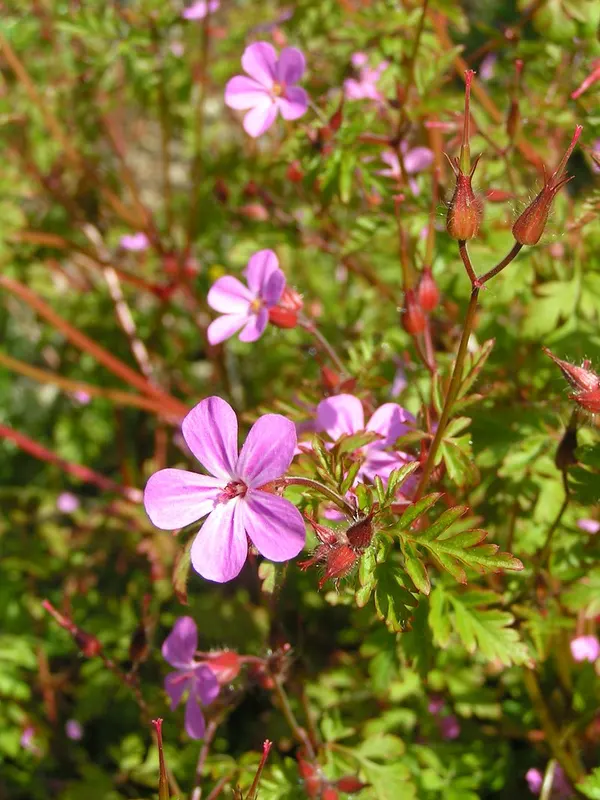
Herb Robert
Geranium robertianum
Other names: Red robin, St. Robert's wort, stinking crane's-bill
Edible plantPhoto credit: Sannse / Wikimedia Commons
Safety information
Safety information
Toxicity: Low at traditional doses; tannin-rich (large/prolonged intake may cause GI upset and reduce mineral absorption). Limited safety data.
Contraindications: Pregnancy/lactation (insufficient data); iron-deficiency anaemia (tannins reduce iron uptake — avoid heavy use); known hypersensitivity.
Interactions: Tannins may bind and reduce absorption of iron, alkaloid drugs and some minerals if taken together — separate dosing; theoretical additive astringent/constipating effect.
Pregnancy & breastfeeding: Insufficient data — avoid.
Evidence level
Reported in folk medicine sources; not clinically validated. Folk and historical sources have not been validated by clinical research.
Preparations
infusion · aerial parts
Part used: aerial parts
Traditional use: astringent for diarrhoea, sore throats, minor wounds(Folk and historical sources have not been validated by clinical research.)
Proposed mechanism: hydrolysable tannins (geraniin), ellagitannins, flavonoids
Associated conditions
Edibility
Edible parts: marginal — young leaves occasionally used as a foraged pot-herb/tea but bitter/strong-smelling and best treated as medicinal
Toxic lookalike warning
Distinguish from other Geranium/Erodium (crane's-bill/stork's-bill) spp.; the strong 'fox/musky' smell and reddish stems aid ID — verify before any internal use
Nutritional notes
Not a significant food source; tannin/polyphenol astringent
Healing traditions
Related plants
- Daruharidra (tree turmeric / Indian barberry)Berberis aristataClinical
- Musta (nutgrass)Cyperus rotundusClinical
- Khadira (black catechu / cutch tree)Acacia catechuClinical
- Kalgan / TormentilPotentilla erectaClinical
- Sangre de grado / Dragon's bloodCroton lechleriClinical
- Amur cork tree bark / huang bai (黄柏)Phellodendron amurenseClinical
Sources (3)
- Herb Robert (Geranium robertianum) — Herbal Reality (EN)
- Herb Robert's Gift against Human Diseases: Anticancer and Antimicrobial Activity of Geranium robertianum L. (PMC, 2023)
- Phytochemical composition and biological activities of Geranium robertianum L.: A review (J. Ethnopharmacology)
Sourcing & resources
Affiliate links — we may earn a small commission at no extra cost to you.